terms-documents

EXPLAINER FOR THE MODEL TERMS FOR MARKETING
DISCLAIMER
This document is provided for general informational purposes only and is not legal advice. It is intended to give an overview of the Model Terms for Marketing (the “Contract”), but it does not replace or modify the Contract itself.
For the full terms, see the Contract.
1. Summary
The Model Terms for Marketing (the MTM) are a standard contract for the advertising supply chain. This document calls the arrangement they create the MTM scheme. Every participant that handles covered data under them is bound by the same rules, and the rules cannot be varied. Not all advertising data is inside the scheme from day one. The MTM governs the covered data brought within it, and leaves other data in the supply chain unchanged.
Under the MTM scheme, advertising works without personal data moving through the supply chain. The scheme is designed so that the personal data stays with the organization the person actually visits or already deals with (the Operator, typically a publisher). Everyone downstream receives a Match Key, a technical reference the scheme leaves them no lawful way to link to a person, bundled with the person’s advertising preference and the metadata (creator domain, timestamp and cryptographic signature). Some AdTech businesses have the technical means to link data like this to other data or to track individuals. The MTM takes the use of those means away by contract. Every recipient warrants that it has no means reasonably likely to be used to identify anyone from the Covered Data, a warranty the contract itself supports, is barred from using the means it has, or acquiring more, to identify anyone, and faces termination, public breach notices and notification of the data protection authorities if it tries.
Under the MTM, covered data is not personal data in the hands of recipients. This position follows from the definition of personal data in the GDPR and from three decisions of the Court of Justice of the European Union, explained in section 5. Those decisions ask a practical question. Can this organization, with the means reasonably available to it, identify a person from the covered data? Where the answer is no, the data is not personal data for that organization, even though it remains personal data for the Operator, who stays fully subject to the GDPR. United States privacy law points the same way, with California’s statute setting out the mechanism expressly (section 6).
The person’s choice sits alongside the Match Key. There are two marketing settings, described in section 4, and both are off until the person makes an affirmative choice, which they can change at any time. Sensitive data is excluded from the MTM scheme entirely.
Today’s approach repeatedly asks people to consent, through banners, to personal data being shared with hundreds of companies they have never heard of and do not need to know about. While this is lawful, it creates friction for the Open Web, friction that “walled gardens” have removed for themselves by asking for consent once across many products. Instead, the MTM approach removes the personal data from the supply chain. It also changes the incentives of the supply chain participants. A business that breaks the MTM contract is cut off from receiving data, while a business that keeps to the contract can point to its participation to set itself apart. We think that is a better answer for people, publishers, advertisers and regulators, and the rest of this document explains why.
2. The problem
The modern web is funded by advertising. Journalism, creative work and specialist information are free to access because publishers sell advertising space. Privacy law is right to demand that this does not come at the cost of people’s data being taken without meaningful control.
But the way consent is implemented today has failed the people who use the Open Web and the publishers who depend on it. People face cookie banners that are too frequent, too complex and too legalistic to produce real understanding, and consent collected this way launders the broadcast of personal identifiers and browsing data to a long vendor list in real-time bidding. Critics of that system are correct. Consent collected through fatigue does not amount to a real choice, and a bid request that carries a person’s identifiers to hundreds of recipients does not protect that person.
Fixing this by concentrating advertising inside a single browser or platform ecosystem creates a different harm, handing control of the Open Web’s funding to a handful of gatekeepers. Removing personalized advertising from the Open Web while retaining it for others would destroy the economic model for the Open Web. A decentralized answer is needed that addresses the privacy problem while fostering competition.
3. How it works
The MTM scheme is built around a technical signal called a Match Key.
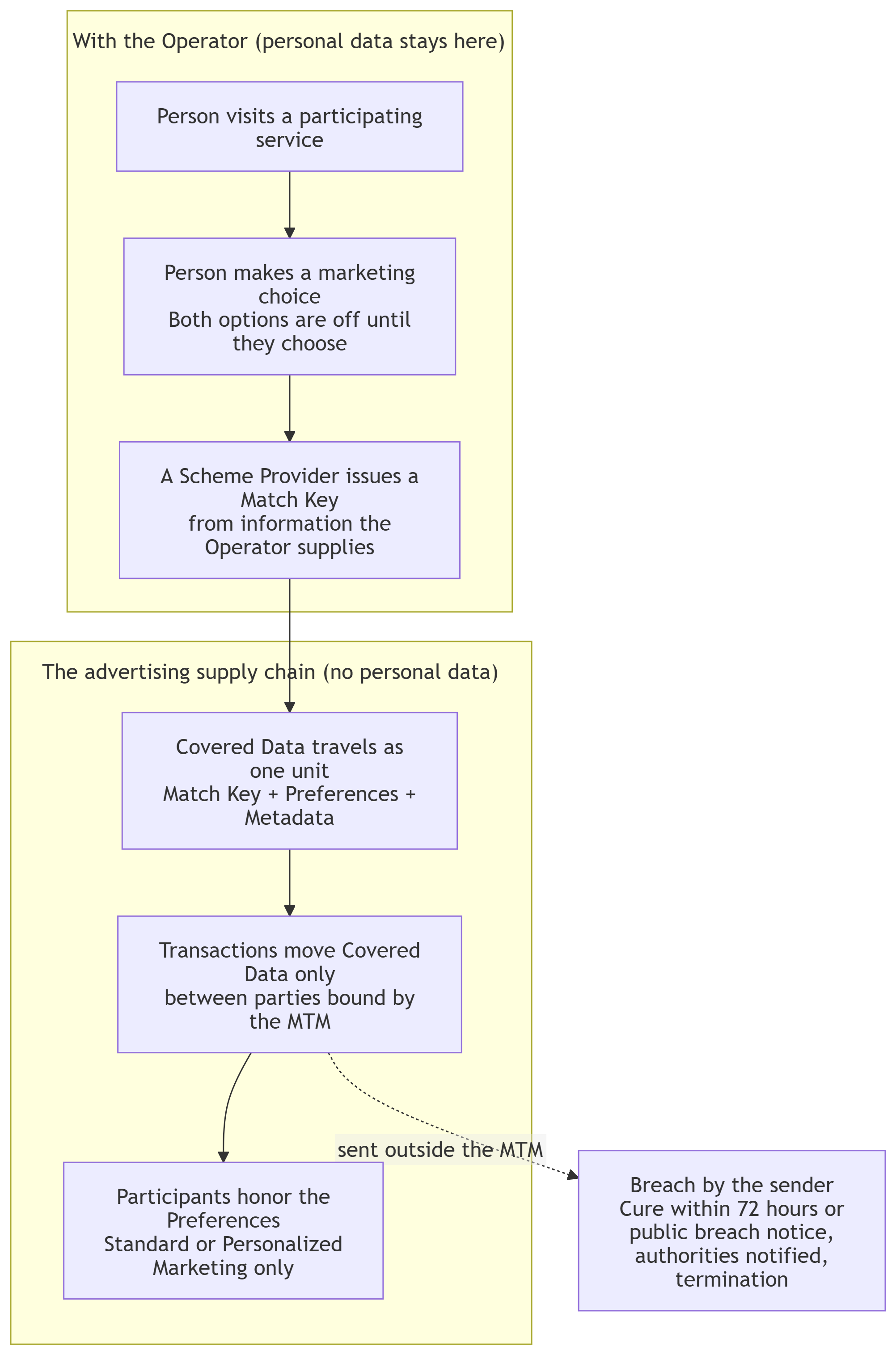
- A person visits a participating service. The service, or the party operating on its behalf, is the Operator. The Operator is the only participant with a relationship with the person, and the design intent is that only the Operator holds the underlying personal data.
- The person makes a simple advertising choice (section 4). The Operator collects that preference.
- A Scheme Provider issues a Match Key from information the Operator supplies. This step happens on the Operator’s side of the scheme, where the personal data stays and privacy law applies in the ordinary way. The Match Key is just a reference. Any technology provider can act as Scheme Provider under the MTM scheme, which is neutral about who creates the Match Key.
- The Match Key, the person’s Preferences and the Metadata travel together as one unit, called Covered Data. The Metadata is the creator domain, a timestamp and a cryptographic signature. It records where the data came from and when, and supports checking that the data has not been altered. Features beyond this are a matter for competition between Scheme Providers.
- Covered Data moves only through Transactions, controlled exchanges between parties who have both agreed to be bound by the MTM. Sending Covered Data, whole or with parts stripped away, to anyone not bound by the MTM is a breach by the sender.
Every participant that receives Covered Data is bound by the same core obligations. There is no first-party or platform exemption. In brief, a participant must:
- honor the person’s Preferences, so a Match Key is never used for personalization the person has not chosen;
- use Covered Data only for a closed list of purposes (delivering, measuring and optimizing content, security and fraud prevention, product development, and legal compliance);
- never attempt to identify the person associated with a Match Key, and warrant that it cannot;
- never use sensitive data (racial or ethnic origin, political opinions, religious or philosophical beliefs, health, sex life or sexual orientation, genetic or biometric data, criminal history, or anything else classed as special category data) in connection with Covered Data;
- apply appropriate security and publish a notice explaining how it handles Covered Data; and
- report breaches, cure them within 72 hours or publish a public breach notice, and notify the relevant data protection authorities where a breaching participant fails to cure or to publish the notice.
A breach can also lead to termination of the participant’s right to receive data under the MTM.
4. The person’s choice
People are offered two settings, both off by default.
Standard Marketing allows the Match Key to support the ordinary machinery of advertising that does not draw on the browsing or interactions associated with the Match Key, such as technical ad delivery, billing, measurement, attribution and optimization.
Personalized Marketing additionally allows the Match Key to be used to select advertising related to the browsing or interactions associated with it, always subject to the MTM scheme.
In both settings the activity involved is the history of the Match Key, not of a person. At best it relates to a device and a piece of software over some period of time.
Nothing is enabled until the person makes an affirmative choice, and the choice can be viewed and changed at any time through the preference interfaces of participating services. The scheme asks for this affirmative choice even though recipients hold no personal data. That is deliberate, and it goes further than the law requires of the recipients. The Operator’s own duties under privacy law are separate and unchanged. One clear, durable decision replaces vendor lists and purpose descriptions that few people read. The MTM does not itself remove repetition, so people will be asked on each site they use, although implementors can choose to share the interface and the stored response across sites and devices. The MTM leaves that choice to competition.
A person who declines both settings, or never engages with the question, ends in the same position as if nothing had been asked. Both settings stay off, and a recipient of Covered Data that carries no Preference may not use it for either form of marketing. Services can still sell advertising chosen from the content of the page being viewed, as they always have. Choosing the ad that way uses no data about the person, and that contextual advertising sits outside the scheme entirely.
Browser-level signals such as the Global Privacy Control (GPC) sit alongside this choice without changing who makes it. GPC tells businesses not to sell or share the person’s personal data, and the scheme meets that instruction by design, because recipients are sent no personal data to sell or share. The marketing question is a different and narrower one. It is asked of the person by the service through the preference interface, and only the person’s answer there creates a Preference. A browser-wide signal turns nothing on, and with both settings off for everyone by default it has nothing to turn off. A person whose browser sends GPC can still choose Standard or Personalized Marketing, and that affirmative, service-specific choice governs the Preference. Section 6 explains how California’s rules on preference signals support this reading.
5. Why this data is not personal data in recipients’ hands
The GDPR defines personal data as information relating to an identified or identifiable person (Article 4(1)). Recital 26 explains how to judge identifiability. Account should be taken of all the means reasonably likely to be used, considering the cost, time and technology involved. Data that one organization can link to a person may therefore be impossible for another organization to link to anyone. The question is always asked of a specific holder with specific means. Three decisions of the CJEU establish this.
Breyer (C-582/14, 2016). A dynamic IP address held by a website operator was personal data only because German law gave the operator a lawful channel to obtain the linking information from the internet provider. The Court held that identification must be practically and lawfully possible, not merely conceivable, and that means are not reasonably likely to be used where identification is prohibited by law or practically impossible. An abstract, theoretical risk does not make data personal.
SRB (EDPS v SRB, C-413/23 P, 2025). The Single Resolution Board shared pseudonymized comments with the consultancy Deloitte. The Court confirmed that identifiability must be assessed from the perspective of each recipient, and that pseudonymized data is not automatically personal data for every recipient in every circumstance. Where the recipient has no lawful means to obtain the additional information needed to identify anyone, the data is not personal data in its hands, even though it remains personal data for the sender.
Scania (C-319/22, 2023). A vehicle identification number is not, in itself, personal data. It becomes personal data only for someone who reasonably has the means to connect it to a specific person.
Now apply that test to the MTM scheme. Many advertising businesses have the technical means to link a reference like a Match Key to other data. The MTM takes the use of those means away. Through the scheme a recipient receives no name, no contact details, no raw identifiers and no browsing history tied to an identity. It warrants that it has no means lawfully available to be used to identify anyone from the Covered Data, and it is barred from using the means it has, or acquiring more, to identify anyone, including by combining Covered Data with other data it holds. Any attempt is a breach that exposes it to termination, a public breach notice and notification of the data protection authorities.
The prohibition is contractual and carries penalties. It is published publicly and it cannot be varied. Breaking it risks discovery through the notices the scheme requires and the scrutiny of counterparties and regulators, and the consequence is ejection from the scheme. Whether means are reasonably likely to be used is a practical question. Under the scheme a recipient could identify someone only by breaching an enforceable contract, losing its data supply and advertising its own wrongdoing. Such a recipient is not reasonably likely to use those means. On the test in Breyer, SRB and Scania, the Covered Data is not personal data in the recipients’ hands.
This holds for recipients of every size, including those with unusual technical reach. A large platform may hold other data. Nothing in the scheme bars such a business from participating, as the MTM supports this, because putting any capability to work on Covered Data breaches the MTM, with consequences by way of termination, public breach notices and regulator notification. Whether means are reasonably likely to be used is judged with those consequences in view. The route to adoption is therefore the same for the largest platform as for the smallest business.
The same data remains personal data for the Operator, who does hold the relationship with the person. The Operator stays fully subject to the GDPR and ePrivacy rules, including for the preference collected through the interface. The analysis is specific to each holder and its means, which is what the Court requires. It is not a blanket claim that anything pseudonymized is anonymous.
Two further points support this reading of the GDPR. First, the technical and contractual measures work together. Recipients are not sent identifying data through the scheme, and the MTM restricts the means a recipient might otherwise use on the data it does receive. That is the complementary role contractual measures are meant to play. Second, Recital 4 of the GDPR states that data protection is not an absolute right and must be balanced against other rights and its function in society, in accordance with proportionality. A scheme that funds open, plural media while giving downstream recipients no ability to identify anyone sits within that balance.
The EDPB’s draft anonymization guidelines, open for comment until 30 October 2026, set a test relevant to schemes like this one. Contractual measures, the draft says, should complement technical measures and must be reliable, verifiable and enforceable. The MTM is built to meet that test. The technical design means recipients are not sent identifying data in the first place. The contractual layer is a single published text that cannot be varied. The Metadata (creator domain, timestamp and cryptographic signature) supports checking where data came from and whether it has been altered. Participants must publish notices explaining how they handle Covered Data, and the obligations are backed by cure periods, public breach notices, notification of supervisory authorities and termination. Where the EDPB draft goes further and suggests that a pseudonym used to distinguish one person from another may itself identify them, that is difficult to reconcile with the court authority set out above, and it is a point the consultation will test.
6. The position under United States law
The GDPR is not the only regime that matters. United States state privacy laws reach the same result by a more direct route, and California, whose law is among the most developed of them, writes the route into its statute.
The California Consumer Privacy Act, overseen by the regulator now known as CalPrivacy, excludes deidentified information from the definition of personal information. Its test for deidentified information has three parts. The holder must take reasonable measures to ensure the information cannot be associated with a consumer or household, must publicly commit to use it only in deidentified form and never attempt reidentification, and must contractually oblige every recipient to meet the same conditions. The MTM design meets each part. The technical measures keep identifying data out of the flow, the notice each participant must publish about its handling of Covered Data is the public commitment, and every Transaction carries the same obligations to every recipient. Most other state privacy laws copy the same three-part definition.
The exclusion of deidentified information also determines how the CCPA’s opt-out rules apply. A “sale” or “share” under the CCPA is a disclosure of personal information, so a Transaction, which carries only deidentified Covered Data, is neither. The Global Privacy Control signal, which California requires businesses that sell or share personal information to honor, is a request to opt out of exactly those disclosures. The CCPA regulations state that treating the signal as an opt-out request is not required for a business that does not sell or share personal information, and where the signal conflicts with a choice the person has made directly with a business, the regulations let the business explain the conflict and follow the person’s affirmative consent. The person’s answer in the preference interface is such a choice. The scheme honors what the signal asks for, which is no sale or sharing of personal information, while the marketing decision stays with the person. The Operator’s own duties for any personal information it sells or shares outside the scheme are untouched.
Established practice already relies on the same kind of separation. Apple states that a person’s reading activity in Apple News is linked to an identifier specific to News and is not associated with their Apple Account. Apple’s California privacy disclosures point to its privacy policy for the personal information it collects, and the News identifier does not appear among the categories listed there. A company facing intense privacy scrutiny treats that separated identifier as falling outside those disclosures, even though it is used to choose which stories a person sees. The MTM gives the open supply chain the same architecture. Apple maintains the separation inside its own products through corporate policy, and the MTM is designed to apply it across thousands of independent businesses through a published contract that binds every recipient.
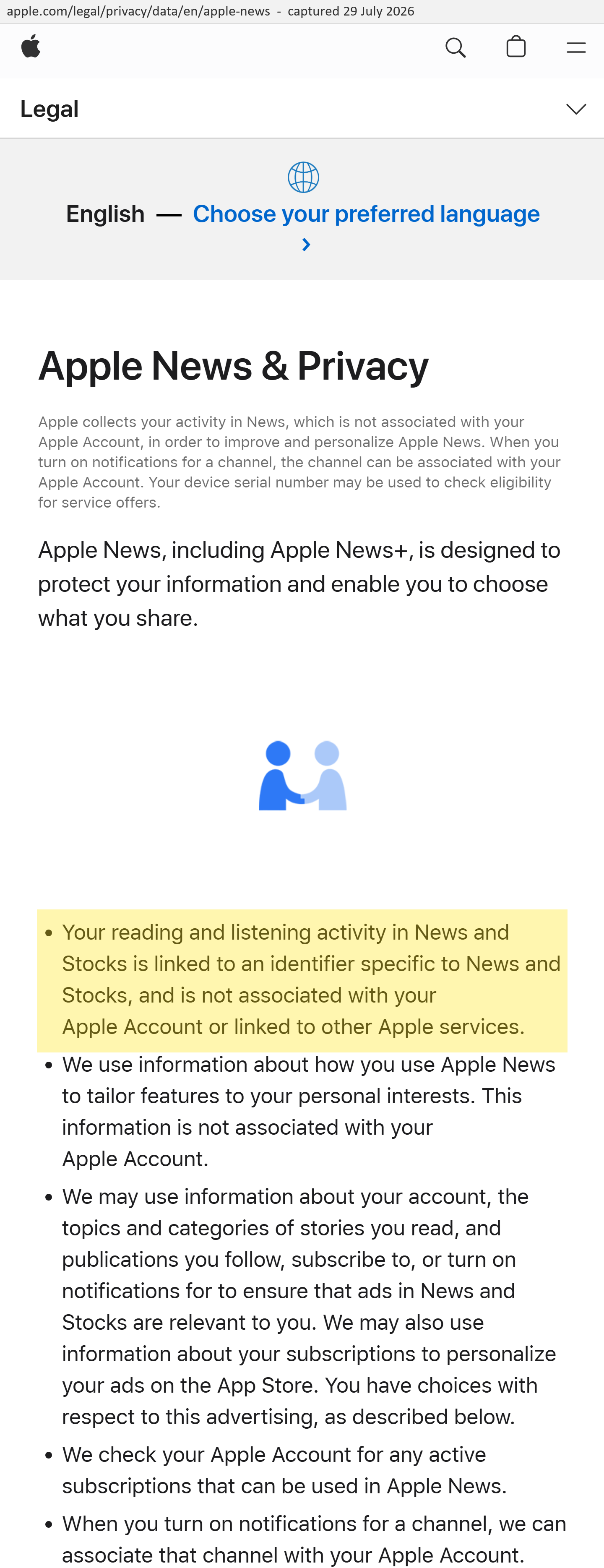
Apple News & Privacy (apple.com/legal/privacy/data/en/apple-news), captured 29 July 2026
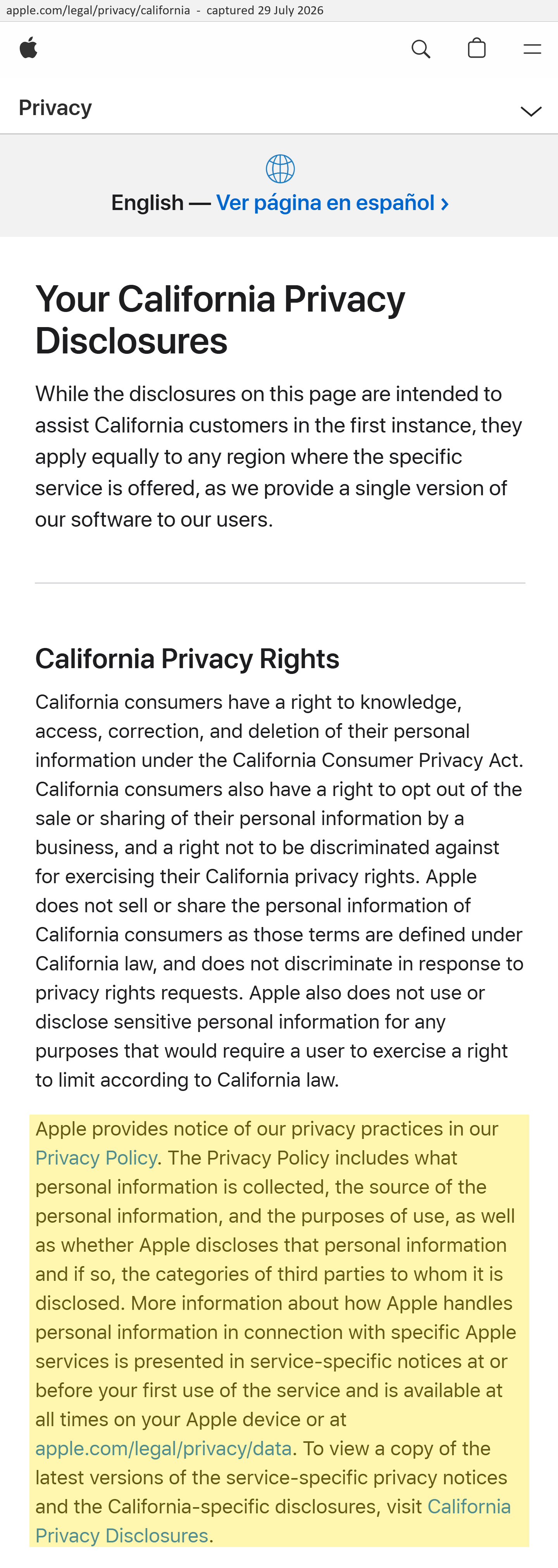
Apple, Your California Privacy Disclosures (apple.com/legal/privacy/california), captured 29 July 2026
7. Why this is better than today’s established practice
For people. Today a person’s identifiers and activity are shared, under rushed consent or legitimate interest, with vendor lists they cannot evaluate. The MTM scheme is built so that no personal data about them is sent beyond the service they chose to visit, sensitive data is excluded entirely, defaults are off, and a single understandable choice about marketing for each service replaces cookie banners.
For publishers and the Open Web. Publishers keep the advertising revenue that funds their content without exposing their audiences to the supply chain, and without ceding their businesses to a platform gatekeeper. A diverse, competitive media ecosystem depends on publishers keeping both the revenue and their independence.
For participants. The MTM inverts today’s incentives. A participant that breaks the rules faces being cut off by every counterparty, because once it is outside the scheme, sending Covered Data to it becomes a breach by the sender. The published terms, the processing notices, the breach notices and the notifications to authorities all leave evidence that is available if an investigation ever takes place. For good actors that same evidence counts in their favor. We expect participants to state in their privacy notices that they are bound by the MTM, so who takes part can be seen, with each participant deciding its own disclosures, as suits a decentralized scheme. In the United States a public statement of that kind has force of its own, because a business that claims to follow the MTM while breaking it invites a deceptive-practices action by the Federal Trade Commission under Section 5 of the FTC Act, in addition to its liability under the contract. Participation therefore gives a business evidence of good conduct that counterparties and regulators can check for themselves, while today such claims have to be taken on trust.
For regulators and DPOs. Today, verifying the AdTech chain means auditing thousands of individually drafted privacy policies and unverifiable consent strings. Under this scheme there is one published legal contract to review instead, and no party can vary it. The Metadata (creator domain, timestamp and cryptographic signature) supports checking the origin and integrity of the data moving through the chain. Breaches must be cured within 72 hours or made public in a breach notice, and authorities must be told when neither happens.
The current interpretation of the GDPR in AdTech tolerates personal data flowing to hundreds of parties under a mass joint data controller arrangement, provided a consent string allows this. The MTM scheme takes the personal data out of the flow instead. The result is less data, fewer parties holding personal data, stronger enforcement and a real choice for people.
8. What the scheme does not do
It does not claim privacy law no longer applies. The Operator remains a controller with full GDPR and ePrivacy obligations in Europe, and obligations under the CCPA and other state laws in the United States. It does not create hidden tracking, and it does not centralize advertising identity in one platform. It is not a blanket anonymization rule. The status of Covered Data in any hands is a fact-specific question. The scheme is designed so that recipients lack the means reasonably likely to be used to identify anyone from the Covered Data. The data they are sent tells them nothing about a person, and the MTM takes away the linking they might otherwise attempt. A regulator can verify the first by examining the data itself and the second by reading the published terms.
The exclusion of sensitive data draws the line at the data itself, not at anyone’s motives. A visit to a Spanish-language news site or to a health publication is not, by itself, information about a specific person’s ethnicity or health, and nothing in the scheme stops advertising from appearing with that content. What the scheme bars is turning activity like that into a conclusion about a specific person’s protected characteristics and attaching it to a Match Key, however benign the intended use. A narrower rule aimed only at discriminatory outcomes, in areas such as housing, credit or employment, would depend on judging every participant’s purposes, which cannot be verified across thousands of parties. A ban on the data itself can be checked by examining what a participant stores. The exclusion restricts what may be recorded against a Match Key. It does not reach data that never enters the MTM, so other data can still be used in parallel outside the scheme.